
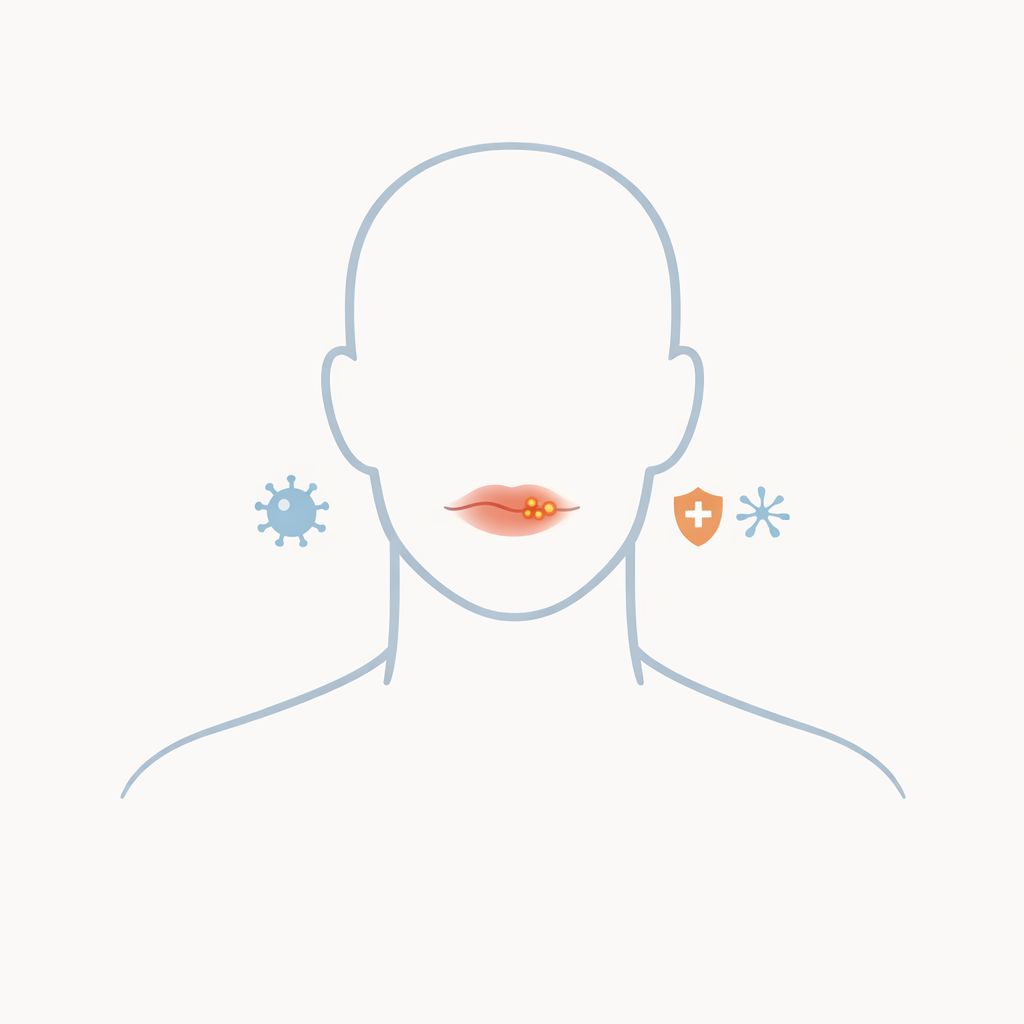
Cold sores
Cold sores are small blisters that develop on the lips or around the mouth, caused by the herpes simplex virus type 1 (HSV-1). The virus is extremely common, and most people are first infected during childhood.
After the initial infection, HSV-1 remains dormant in the nerve cells and can reactivate periodically, causing recurrent cold sores. Triggers may include stress, fatigue, illness, sun exposure and hormonal changes.
Cold sores typically clear up on their own within 7 to 10 days. Antiviral creams and tablets can help reduce the severity and duration if used early.
An HSV-1 antibody blood test can confirm whether someone has been exposed to the virus, though it cannot determine whether the virus is active at the time of testing.
Causes of Cold sores
Cold sores are caused by herpes simplex virus type 1 (HSV-1). Initial infection usually occurs in childhood through close contact such as kissing or sharing utensils with someone who has an active cold sore.
After primary infection, the virus travels along nerve fibres and establishes lifelong latency in the trigeminal nerve ganglion. Reactivation triggers include:
- Stress and fatigue
- Illness or fever (hence the name "fever blisters")
- Sun or wind exposure to the lips
- Hormonal changes, such as during menstruation
- A weakened immune system
Some people experience frequent recurrences while others rarely or never have outbreaks despite carrying the virus. The virus is most contagious when sores are present but can also be shed asymptomatically.
Tests that can help check this condition
 Learn more on the official NHS page .
Clinical review

Dr. Shahzaib Ahmad MBBS, BSc, MRCP, FRCA, FFICM
Clinical Supervisor - Vitall|GMC 7495062|Profile
Reviewed on 13/10/2026
Next review due 13/10/2027
Review focus: Blood biomarkers, laboratory testing methodology, and biochemical interpretation.
